DSML Market Views Article
Atlas Leaves the CES Stage for Hyundai's Georgia Training Centre
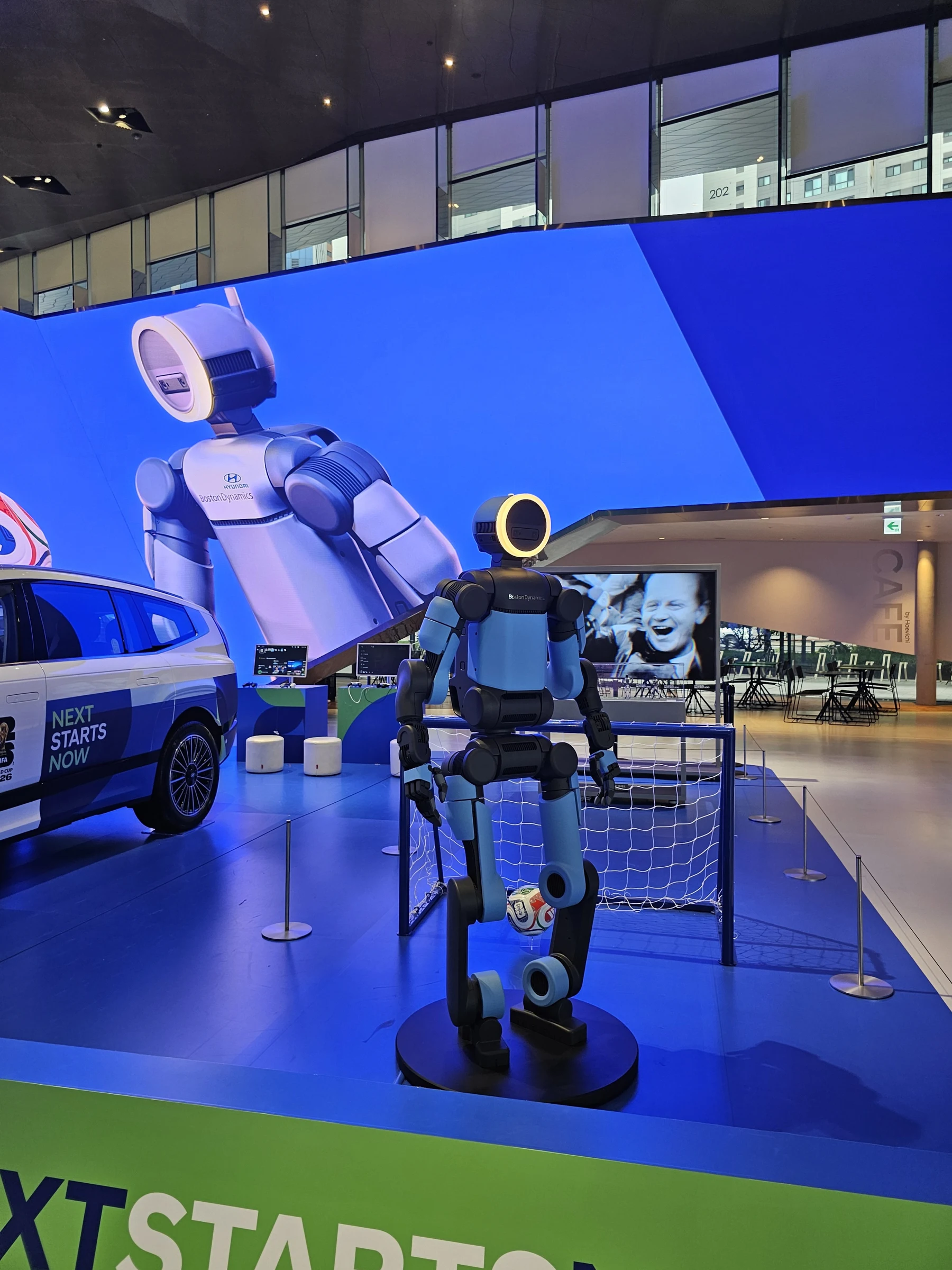
Boston Dynamics unveiled product Atlas in January 2026. By September, robots were training inside Hyundai's Georgia metaplant, while model development and an automotive actuator partnership supplied other pieces of the industrial programme.
Boston Dynamics unveiled product Atlas at CES on 5 January 2026 and announced immediate manufacturing plans, with the year's deployments allocated to Hyundai's application centre and Google DeepMind. On 21 September it reported the Georgia application centre open and Atlas robots training there.
Hyundai supplied more than a future market for a humanoid. Its manufacturing group brought a place to learn factory tasks, a components business to work on actuators and a route towards repeated deployment. Boston Dynamics added the robot and its control expertise; Google DeepMind joined the model-development effort. The concrete 2026 advance was the move from a launch and allocated placements into an operating training centre.
Hyundai planned to use its own factories as training grounds before introducing Atlas to repetitive sequencing work from 2028. Its January production-system objective was 30,000 robots annually by that year; September brought a separate intention to deploy an initial 25,000 Atlas units across Hyundai and Kia plants over the following years. The immediate work was preparing the robot and the automotive supply chain for those later stages.
The Factory Programme Began With an Electric Redesign
Boston Dynamics' own development history places the commercial reset in April 2024, when it introduced an all-electric Atlas. The company was moving beyond the hydraulic research robot associated with demonstrations of balance and movement. It describes electric actuation as a way to reduce complexity and noise while making the machine easier to deploy and maintain.
In 2025, the team concentrated on parts sequencing in automotive manufacturing. That task gave it a concrete setting for work on perception, grasping and whole-body control. Its account describes reinforcement learning in simulation alongside teleoperated demonstrations, and a first metaplant test in Georgia in the autumn.
This history gives the January launch a practical starting point. The robot was being shaped around picking and arranging real parts, with experience from a factory test. Its movement demonstrations came from a longer research programme, but the commercial design was being organised around work in an industrial setting.
Two Versions of Atlas Appeared in the CES Story
At Hyundai's Las Vegas presentation, Boston Dynamics revealed the product version and demonstrated a prototype on stage. CEO Robert Playter presented the launch as the outcome of the company's long robotics work. The announcement said manufacturing at the Boston headquarters would begin immediately and that all 2026 deployments were committed to the Hyundai application centre and Google DeepMind.
Zack Jackowski, then general manager of Atlas, emphasised a less theatrical change: fewer unique parts and components designed to fit automotive supply chains. The product description also included autonomous battery swapping and a link through Orbit software to manufacturing and warehouse systems.
The announced product had 56 degrees of freedom, fully rotational joints, a reach of 2.3 metres and lifting capacity up to 50 kg. Boston Dynamics described autonomous operation alongside teleoperation and a tablet steering interface. Those features placed the humanoid around the reach, loads and working spaces of an industrial task, while giving operators several ways to control it.
Rodriguez and Parada Brought Model Development Into the Programme
The same CES announcement cycle included a Google DeepMind partnership. Alberto Rodriguez, director of robot behaviour for Atlas, described the need for visual-language-action models for complex humanoids. Carolina Parada, then identified as DeepMind's senior director of robotics, presented the collaboration as an exploration of how new models could expand what the machines do.
The partners planned joint research at both companies using Gemini Robotics models and a new Atlas fleet, beginning in the coming months. Boston Dynamics brought physical control and robotic capability; DeepMind brought models intended to help machines perceive, reason and act. Rodriguez and Parada were joining those capabilities around the problem of teaching a complex body a wider range of industrial work.
Mobis Took Its Automotive Components Business Into Robot Joints
Hyundai Mobis supplied another concrete decision during CES. Its release, carrying a 7 January dateline and published on 8 January, announced an actuator-supply collaboration with Boston Dynamics. It called Boston Dynamics its first official robotics customer. An actuator converts a control signal into physical movement, making it central to the robot's ability to lift, turn and grasp.
Mobis linked the move to its experience in automotive component design, production and reliability testing. Se Uk Oh, head of its Robotics Business Innovation Group, described work across development, manufacturing and quality assurance. Jackowski focused on access to automotive cost structures and production scale. As his team reduced unique parts in Atlas, Oh's organisation offered a route to testing the moving assemblies and making them repeatedly.
Training inside an affiliated factory is a substantial step, but it is not the same result as routine productive work on an assembly line. The September opening supports the preparation programme. It leaves the later factory deployment targets, external sales and claimed labour benefits to their own dates.
Hyundai Set a Process-by-Process Calendar
Hyundai's separate release was published on 6 January, following the Las Vegas unveiling. Its roadmap began with repetitive sequencing tasks at Hyundai Motor Group Metaplant America from 2028, followed by component assembly from 2030. The group said deployment would proceed through process-level validation, beginning with work where safety and quality benefits were established.
The plan connected several affiliates. Hyundai Motor and Kia supplied manufacturing environments, Mobis components and Hyundai Glovis logistics capability. The stated 30,000-robot annual production objective belonged to a wider production system, not a disclosed order book for the January product.
This sequencing fits the work Boston Dynamics had already chosen: preparing parts is an entry point into manufacturing, while complex assembly remains a later objective. Hyundai was giving the programme a timetable and internal industrial route without requiring the first robot to perform every job on a car line.
Reported Metrics
- Planned HMGMA sequencing deployment: 2028. Hyundai's target year for sequencing-task deployment at HMGMA. Source 2
- Planned more complex assembly tasks: 2030. Hyundai's target year for component-assembly deployment at HMGMA. Source 2
September Put Atlas Inside an Operating Training Centre
On 21 September Boston Dynamics announced that the first phase of the Robotics Metaplant Application Center was operational at HMGMA outside Savannah. Atlas robots were being trained on logistics and parts sequencing, including arranging automotive components in the correct order for assembly. The centre was the realised follow-through to one of January's named destinations.
Jackowski, identified in September as chief product and technology officer, described a strategy joining supply, production, testing and deployment. A larger building planned for 2027 would expand RMAC to approximately ten times its current size. Boston Dynamics was also discussing further training work with existing Spot and Stretch customers in other industries.
By September, the electric redesign had become a product programme with model and component partners and an operating application centre. Hyundai's 2028 and 2030 factory stages remained ahead. Training on the automotive campus gave that programme a working place to develop the handling and sequencing skills chosen as its first industrial application.
Primary Sources
- Boston Dynamics / Atlas product-version announcement (2026-01-05)
- Boston Dynamics / Atlas development history and current manufacturing statement (Undated company history)


