DSML Market Views Article
Rebellions and Marvell Plan Custom AI Systems for Asia-Pacific and the Middle East
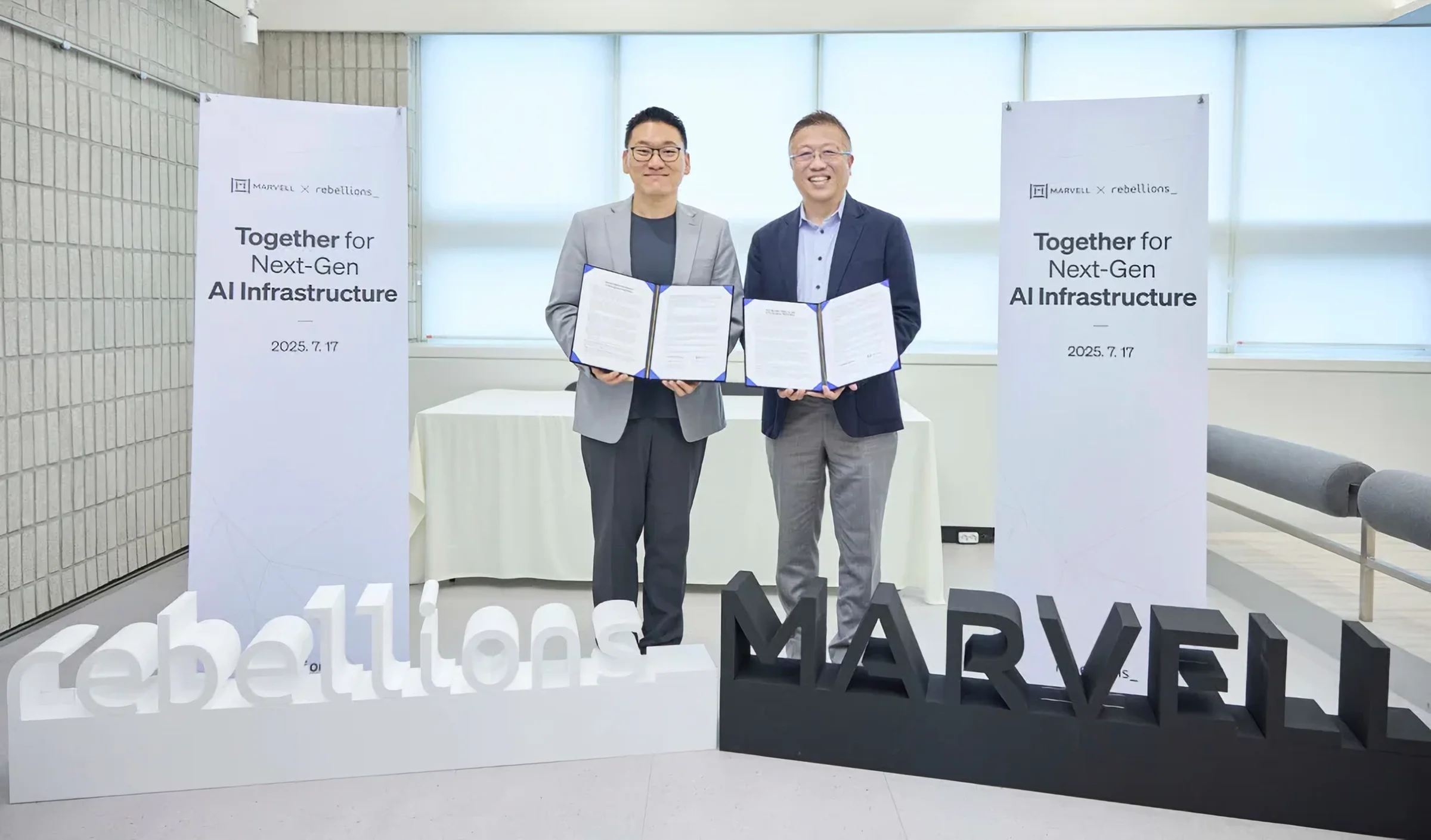
Park and Will Chu agreed an engineering route for regional infrastructure. The decision fitted a wider move from REBEL chiplets to modules and complete inference systems.
On 29 July 2025, Rebellions announced collaboration with Marvell on customer-specific AI infrastructure for Asia-Pacific and the Middle East. Chief executive Sunghyun Park and Marvell custom-cloud-solutions head Will Chu described combining accelerator design with advanced packaging, high-speed SerDes and die-to-die connections. The aim was an integrated inference system for regional and sovereign-backed buyers.
Rebellions was assembling the capabilities around its next chip. The accelerator supplied the computation, but a deployable system also needed a package, high-speed connections and a supported module. Marvell addressed the silicon-integration side of that problem, alongside a separate Pegatron module relationship. The decision shows how the Korean company sought to enter larger infrastructure projects without developing every surrounding technology itself.
The relevant industrial choice was the use of specialised partners at different layers. Pegatron worked on the physical module; Marvell offered custom-platform technology; Rebellions supplied its inference architecture and software. The company was moving towards a larger delivered product, with its August chip demonstration and later rack launch marking different stages of that move.
Pegatron Had Already Taken on the Physical Module
In November 2024, Rebellions and Pegatron agreed to co-develop a module around the next-generation REBEL accelerator. Pegatron chief technology officer James Shue brought a manufacturing and system-design perspective; Rebellions chief technology officer Jinwook Oh stressed the need for both chip engineering and production expertise. Their announcement named electrical, mechanical and thermal work as part of the collaboration, describing it as Pegatron's first advanced-packaging partnership with an AI chip start-up.
The product was not just a processor on a specification sheet. A module had to supply and remove power and heat while maintaining the connections needed by a chiplet-based accelerator. Rebellions described REBEL with 144 GB of HBM3E for large language and multimodal models. Pegatron's contribution addressed how such a device would be incorporated into equipment suitable for production. That relationship preceded Marvell's, giving July's custom-silicon plan a separate hardware-integration strand already in place.
Marvell's May Platform Explained the Engineering It Could Bring
Two months before the Rebellions announcement, Marvell introduced an advanced multi-die packaging platform. It used modular redistribution-layer, or RDL, interposers instead of a conventional silicon interposer spanning the package. Marvell said the platform had been qualified with a major hyperscaler and was entering production. Chu was bringing an established packaging programme to the new collaboration, with engineers already working on the physical challenges of larger AI systems.
An interposer provides the connections beneath compute dies and memory. Marvell's approach placed modular sections around individual dies and connected them through short, high-bandwidth paths. Its demonstrated design integrated four HBM3/3E stacks and supported up to 1,390 square millimetres of silicon. The modular design also allowed an individual die to be replaced within the architecture, giving the platform a way to accommodate different combinations of computing and memory components.
The release named people responsible for bringing that platform together. ASE senior vice-president Mike Hung described close collaboration with Marvell to improve the performance and efficiency of chiplet systems. Amkor chief operating officer Kevin Engel connected the project to its 2.5D packaging capability. Samsung Electro-Mechanics executive Taegon Lee identified custom silicon capacitors and other passive components supporting power delivery. SPIL's CB Chang described process flexibility for the different parts of a design. Chu's packaging strategy rested on several specialist suppliers, each dealing with a different physical part of the finished device.
Marvell also described work towards qualification of future HBM4 packaging. The progression mattered to the sort of custom system Park was seeking: a platform had to accommodate changes in memory and compute without requiring the chip company to build every packaging process itself. The May platform gave the July agreement an industrial setting, with named manufacturing partners and an existing production programme.
Park and Chu Proposed Customer-Specific Infrastructure
July's agreement brought those capabilities to a proposed custom accelerator route. Rebellions would use Marvell platforms, advanced packaging, SerDes and die-to-die interconnects to develop customer-specific systems. SerDes handles high-speed data transmission; die-to-die connections let separate chiplets work together. The announced destination was a tightly integrated rack-scale inference solution.
Park described organisations looking beyond one standard architecture. Chu emphasised performance, efficiency and scalability in customised infrastructure. The stated focus was regional cloud and sovereign-backed initiatives in Asia-Pacific and the Middle East, whose interest in control over computing shaped the intended market. The companies were organising a customer-specific design route around Rebellions' inference architecture and Marvell's silicon-integration capabilities.
Reported Metrics
- Announced product route: Custom development. Joint development of custom AI infrastructure announced in July 2025. Source 1
The Next Public Milestones Were a Chip Debut and a Rack Offer
At Hot Chips in August 2025, Rebellions demonstrated REBEL-Quad and described its Samsung 4nm process, UCIe-Advanced chiplet connections and 144 GB HBM3E. Its account named Samsung's Mijung Noh and Alphawave Semi's Letizia Giuliano as contributing partners. That public debut followed July's collaboration, adding specific manufacturing and IP relationships to the new generation's development.
The subsequent 30 March 2026 launch made RebelRack and RebelPOD available alongside a separate financing. Park's emphasis had widened to the software that made infrastructure usable, including Kubernetes and compatibility with vLLM, PyTorch, Triton, Hugging Face and OpenShift. The offer now extended into a rack and a multi-rack cluster.
The progression changed the scale of the product Rebellions could discuss with infrastructure buyers. Pegatron addressed the module, the Hot Chips demonstration showed the new chip, and the March offer extended into racks with supporting software. The Marvell relationship opened a custom-silicon route within that wider effort. Park's company was joining established engineering and manufacturing organisations to turn its own inference design into systems large customers could deploy.
- Rebellions / subsequent REBEL-Quad Hot Chips debut
- Rebellions / later rack/POD availability and software platform
- Hot Chips organiser / August 2025 event programme
The companies had not identified a completed Marvell-based Rebellions system. Marvell's May hyperscaler qualification belongs to its own packaging platform; it cannot identify the package selected for a later Rebellions product.
Primary Sources
- Rebellions / separate hardware-integration context (2024-11-08)
- SK hynix / later reported memory-market demand and HBM growth; not a disclosed REBEL supply contract (2026-01-28)
- Marvell / production-qualified advanced packaging platform and named ecosystem partners (2025-05-29)
- Rebellions / subsequent REBEL-Quad Hot Chips debut (2025-08-27)
- Hot Chips organiser / August 2025 event programme (2025-08-24 to 2025-08-26 event programme)


